The Mississippi scandal involving federal money intended for struggling families is not your garden variety embezzlement scandal. It’s got a big twist in it, which is troubling.
Embezzlement is defined in the Merriam-Webster dictionary “to appropriate (something, such as property entrusted to one’s care) fraudulently to one’s own use.”
The weird aspect of this scandal is that almost all the money was not stolen for “one’s own use.” It was used for another public purpose that diverged from the original intent. That is a very different matter.
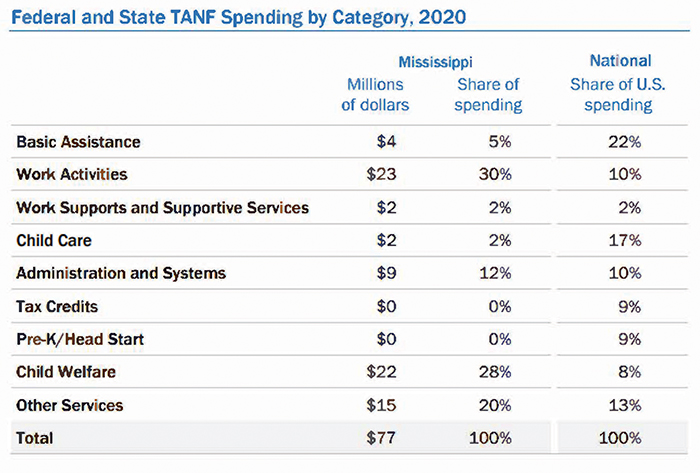
The ability to divert the money was made possible by ambiguity in the block grant language. This gray area led Mississippi officials to repurpose $77 million to other public projects, not to their personal bank accounts.
What’s more, every other state has been doing the same thing for years. The Center for Budget and Policy Priorities has compiled the data for each state. On average, only 22 percent of the TANF money was spent on basic services.
TANF stands for Temporary Assistance for Needy Families. It was created during the Clinton administration in 1996 to replace Aid to Families with Dependent Children (AFDC).
I remember those days. This was a big controversy. Clinton was accused of trying to cut off aid to needy families by replacing AFDC with TANF.
There was a big difference between AFDC and TANF. AFDC was a strict federal program that was administered by the state but in accordance with federal specifications. TANF was a big block grant to states with the flexibility for states to craft their own programs as they saw fit.
The idea was to let different states experiment and enact programs better suited for that state instead of one size fits all.
Included in this flexibility was the ability of states to enact work requirements before receiving the TANF money. Conservative states in the south were quick to impose work requirements which led to a drastic drop in the number of families applying for the TANF money. Between 1996 and 2000, the number of welfare recipients plunged by 6.5 million, or 53 percent nationally.
The federal guidelines to the states for the TANF grant were as follows:
(1) assisting families in need so children can be cared for in their own homes or the homes of relatives; (2) reducing the dependency of parents in need by promoting job preparation, work, and marriage; (3) preventing pregnancies among unmarried persons; and (4) encouraging the formation and maintenance of two-parent families. States define what constitutes a “needy” family for the first and second purposes and do not have to limit assistance to needy families for the third and fourth purposes.
These guidelines include vague words that can be construed widely. For instance, there are unlimited things that could possibly “encourage the formation and maintenance of two-parent families.”
For instance, suppose you used TANF money to help a school for autistic children. You could plausibly argue that such a school could “help the maintenance of a two-parent family” that had an autistic child.
This was the case for Nancy New and the New Summit School which received TANF money. The use of TANF money in that regard could arguably be within the guidelines.
In many ways, the problem is in the name of the program. Over two decades, the TANF program had diverged widely from its original intent, not just in Mississippi but across the nation. Yet the name remained the same. The feds didn’t crack down on the states so the divergence got greater and greater over time.
This divergence reached a peak in Mississippi where TANF money was used to fund a $5 million volleyball stadium at the University of Southern Mississippi.
The Institutions of Higher Learning (IHL) asked Attorney General Jim Hood to determine if this was legal. His staff said it was.
You can see why this is not your ordinary embezzlement scandal. First of all, if this is embezzlement, then the IHL, the Attorney General and many other agencies and non-profits in Mississippi are guilty of embezzlement. Are we going to throw all these people in jail?
The way this plays out legally is very unfair to those lower down in the food chain such as Nancy New and other recipients. The use of TANF money as sort of a state slush fund for pet projects has been going on throughout the nation for decades. But once exposed by the media, it’s embarrassing to the state and federal auditors so there has to be a sacrificial lamb.
The first thing the prosecutors do is find some minor expenditure that benefitted the fund recipient personally. When you have that kind of money sloshing around, there’s going to be some abuse somewhere. That’s the low hanging fruit. Then they use the abuse on the minor amount to impugn the entire program. Such federal and state prosecutions are a racket in themselves.
Here’s where it gets really slimy. The sacrificial lambs are persuaded to plead guilty with a slap on the wrist if they rat on the higher ups. By this time, prosecutors are looking for bigger scalps, perp walks and career-building name recognition.
So far Nancy New and John Davis have yet to go to prison. Their harsh state sentences are subservient to the federal plea bargain, which may or may not involve jail time. I’m betting they will never go to jail because of the ambiguity of the case.
All of that being said, Phil Bryant, Brett Favre and the others caught in this net could have avoided this by using some basic common sense. No matter what the legal eagles say, you have to think how this would go over in front of a jury of common folks. If the program is named “Temporary Assistance for Needy Families” how are you going to justify a volleyball stadium or a workout clinic to the jury? In the end, a jury decides what is legal and illegal. It’s got to pass the smell test.
When you use public money, you must err on the side of caution. If not, a scandal can blow up in your face. And that’s exactly what has happened.